Sunday, August 26, 2012

Gaudi, the Architect of Dreams

Building decorated by Picasso himself
In Spain, people sleep during the day and eat/dance/love during the night. You see families with small children enjoying a casual dinner at midnight, and if you show up to a bar before 2 a.m., chances are the doors aren't even open. We arrived via bus around 6 p.m. and went straight to the Gothic Quarter with it's fabulous mix of old and new buildings. There are ancient cathedrals nestled right in with buildings that have Picasso's figures sketched in the cement. Barcelona (or Barthelona as the locals pronounce it) is famous for it's tapas, or "small plates." We focused the remainder of our evening on consuming as many varieties of these small little tapas plates as possible and challenging the locals to a little game of "who can stay out later."

The look-out area with a view of Barcelona 
The tapas restaurant we ate at was set up like a buffet, you picked up a plate at one end then made your way down the row, picking up any  little dish that caught your eye. There was everything from paella rice dishes to bruschetta, chicken on a stick and slimy eel delicacies. Each tapas had a little toothpick stuck inside and the waiter tallied your total by adding up the number of toothpicks you had accumulated. Barcelona is also well known for it's sangria so we made sure to order a few pitches of that as well. We ate our tapas with a view of a building decorated by Picasso himself and we congratulated ourselves in making it this far. According to our tour guide, at this point in the trip someone had usually been arrested, deported, or hospitalized. We were so far 0 for 3.

La Sagrada Familia
The next day was one of the best architectural feasts for my eyes that I had experienced up to this point. We started the day off by driving to a look-out site with a view of the entire city, including the bay that mom and Grandma Aften's cruise ship will depart from in just a few weeks! We took pictures from above then piled back in the bus to get up close and personal with the city so many people adore. We first visited the Sagrada Familia, a massive cathedral designed by Antoni Gaudi.The Cathedral has been under construction for over 130 years and they expect it will be at least another 50 before it's complete. The massive cathedral combines Gothic architecture with art nouveau details and towers that look like melting wax. Every square inch is covered with elaborate sculptures and scenes, it's easy to see how such a project might take a few hundred years.

The Hall of 100 Columns
We then headed over to the next Gaudi creation, park Guell. The park was a failed attempt at an upscale housing complex which resulted in a dream-like city park, complete with elaborate tunnels, mosaic benches, and a perfect view of the city. An iconic mosaic dragon, whose picture is seen everywhere around the city, greets visitors at the entrance of the park. After ascending a small flight of stairs you enter the Hall of 100 columns. Randomly placed and all white, the columns provide any child's ideal hide-and-seek fort. While the children run and duck behind the never-ending rows of identical columns the adults crank their heads and marvel at the beautiful round mosaics that cover the ceiling.

The Hall of 100 Columns actually supports the terrace of a large park designed specifically to enjoy the view of Barcelona. Benched rows sneak their way, in an uneven oval, around the outline of the park and are smothered in techni-colored mosaics. Parrots sing from nearby palm trees and the city of Barcelona sleeps, waiting to rouse itself for the night.

Casa Battlo
Living room of the Casa Battlo
My third and final Gaudi visit of the day was to the Casa Battlo, a private residence that Gaudi restored between 1904 and 1906. Gaudi avoided using straight lines completely, so all doorways,windows, cabinets and stairs are curved and spiraled. He plastered the outside of the house with sunbursts of brightly colored tile. The house itself is supposed to represent a dragon, with the stairway being his spine and the chimneys his snout. The interior of the house makes you feel as though you're inside a  giant seashell with softly curving walls and oceanic colors. For those of you who are familiar with Gardner, KS, it seemed similar to the store The Dolphin Song, but a much larger and more elaborate scale. I also think that Michael Reynolds, the man who designs earthships, probably found inspiration in Gaudi's style.

Icebarcelona
My remaining day in Barcelona consisted of soaking up the sun on the beach and adding a layer of Spanish sunburn to my french tan. That night we visited "Icebarcelona" an ice bar located right on the beach. The temperature was below freezing inside so they immediately equipped us with parkas and gloves. Ice statues stood in every corner and even our cups were made of ice, forcing us to drink quickly before the heat of our hands caused the cups to melt away, spilling our drinks all over the floor. We cheersed our icy beverages to a time well spent and prepared to depart the next morning for our final city, Madrid.

Monday, August 20, 2012

THE REAL Game of Thrones

Carcassonne defense fortress, France
Our final stop in France was at the town of Carcassonne which is centered around a massive fortified castle. We had two hours to explore the ancient castle and grab a bite to eat. At this point of the tour I was so happy to have Alexa by my side. Alexa is a medieval history major from San Francisco and she is a living encyclopedia who loves her topic. We strolled around the castle walls and saw the skinny little windows used to fire arrows out of. The inside of the castle was pretty much like the Renaissance festival on steroids. Shops lined the streets selling all forms of swords and shields, medieval costumes with elaborate hoods and t-shirts with knights and ladies on them.

At this point in the trip I had completed two of the five Game of Thrones books which take place in a medieval imaginary world. This allowed me to have a whole complex story to accompany the castle world I was exploring. I pictured Bran falling from one of the high, stone towers and his brothers practicing their sword fighting in the yard below. I wondered if this castle had an ancient crypt below it's walls as well. I pictured knights galloping across the thick wooden draw-bridge and and the elaborate feasts that would accompany their arrival. I might have been nerding out pretty hard at this point...but I love all things medieval and this town simply fueled the passion. If I could have lived in any time period it would be the medieval world...but my two requirements would be that I was of noble blood and I would need penicillin.

Lavender Fields Forever

Gloomy fresco at the Palais des Papes, Avignon France
After Nice we set sail for Province, France: the countryside that inspired Monet and many other artists with it's lavender fields that stretch as far as the eye can see. We stopped for lunch in Avignon and went on a self-guided tour of the Palais des Papes, the residence of all Popes from 1309 to 1433 AD. After going through about 5 of the extremely hot and humid, cramped rooms I decided I'd seen enough and headed for the exit.  The only really interesting architectural aspect of the Palais des Papes was a fresco painted on the ceiling of the first room, instead of the popular multi-colored frescoes of Renaissance Italy this one was done entirely in shades of grey and black resulting in a rather gloomy, creepy ambiance. I spent the rest of my time in Avignon shopping for lavender souvenirs which I brought home for all the ladies in my family. I was also pleasantly surprised to stumble upon a dusty train-hopping group of kids playing some honky-tonk tunes for a small crowd. They sang in English and were great, I was pretty content standing there stomping my feet and breathing in the calming smell of Lavender. As a bonus, I bought a beautiful blue polka-dot dress on my way back to the bus.

Pont de Gard, ancient Roman aqueduct bridge
Only a short distance from Avignon we stopped to see the ancient Roman aqueduct bridge named the Pont de Gard.The impressive, three-tiered bridge was part of the 31 mile long Nimes aqueduct used to carry water from a spring at Uzes to the Roman colony of Nimes. Built in the 1st century AD the Pont de Gard is the highest of all aqueduct bridges. It's a popular French tourist destination and below the bridge were dozens of people swimming and floating lazily down the river.

A few more hours down the road we stopped for dinner in the town of Nimes. Here we took a self-guided tour of the huge Nimes Amphitheater which was similar in design to the Colosseum of Rome and is the best preserved Roman amphitheater in France. It probably would have been much more impressive if we hadn't already seen the Colosseum, but one aspect of the Nimes amphitheater that makes it interesting is that concerts and bull fights are still held there today. One guy in our group actually traveled to Nimes from Paris in order to see Blink-182 perform and he said that the acoustics were spot on.

The still used amphitheater in Nimes, France
We wrapped up the day by arriving in our hotel in Province. The area around our hotel was really rural, so Alexa, Justine and I ate dinner at the hotel with our tour director Mark. He brought a bottle of wine that our bus driver's Italian family had made at their Tuscan winery. It was a light red and went deliciously with dinner. We all hit the sack early because the next day we would say goodbye to France once and for all to arrive in Spain!

The Leaning Tower of Cheesa and the French Riviera

Piazza del Deumo, Pisa
Because the museums were closed in Florence on the one day we were in town, many members of our group resorted to drinking at little cafes and pubs. Needless to say, the next day on the bus we were one sorry looking group, most people were slumped against windows nursing hangovers and catching up on lost sleep. The good news was that our next destination is the darling of European beach towns, Nice. We were all looking forward to some relaxing beach time after 20 days of intensely populated cities and non-stop site seeing.

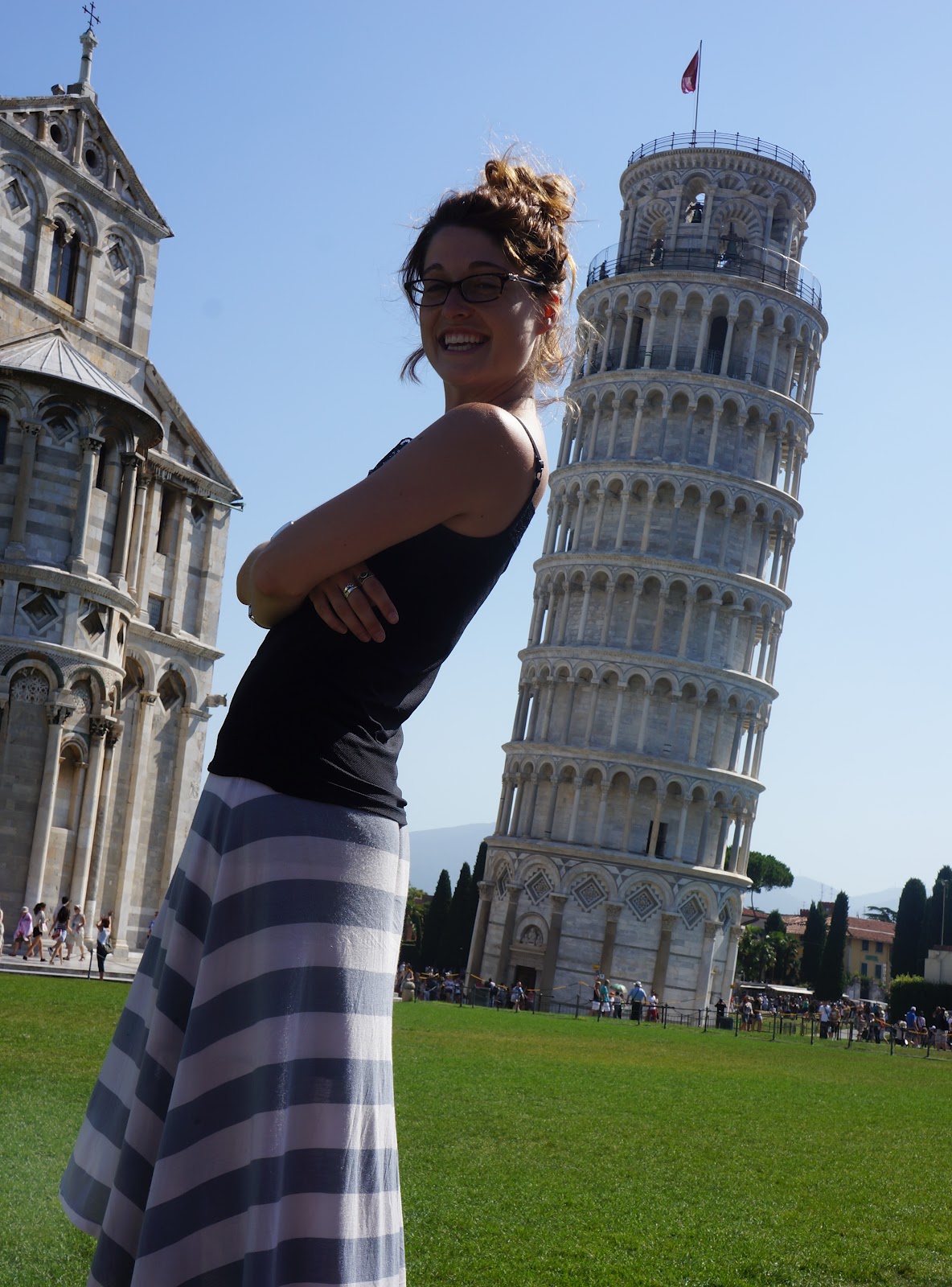
Our drive to Nice was picturesque as we cruised along the Mediterranean coast. We saw expansive fields with little farmhouses nestled between fence rows of tall, pointy cypress trees. After a few hours of driving we stopped in Tuscany at the ancient town of Pisa  to see for ourselves if the tower really does lean. We parked the bus and walked straight to the Piazza del Duomo where three historic buildings are located; The Baptistery, the Cathedral, and the Cathedral's famous free standing bell tower, more commonly known as the Leaning Tower of Pisa. The Plaza is beautiful with a huge lawn of perfectly manicured grass.

The leaning tower of Pisa!
The tower began leaning before construction was even complete. The leaning is due to an inadequate foundation on ground that is too soft on one side to properly support the tower's weight. Construction of the tower happened in three stages over the course of 177 years. Rumor has it that Galileo dropped two cannonballs of different weights off the top of the tower to demonstrate that speed of descent is independent from mass.  Tourists have to stand on top of little fence posts in order to get good shots with the tower so in lines all up and down the main sidewalk were tourists of every race and religion awkwardly balancing on narrow fence posts, taking the same goofy shot "leaning" against the tower. Don't worry I got one too.

After seeing Pisa we crossed the border into France and began our drive along the French Riviera. We passed town after town of whitewashed buildings, stacked in tiers against the mountainside with the ocean glittering in the background. These coastal villages actually looked the way I had always pictured Greece, white and pristine with men unloading fish on the docks. We passed Monaco, a small country of it's own that is a famous get away for high-ballers with gambling addictions. Around 3 p.m. we pulled into Nice.

Nice, France
My first personal success story for Nice was tracking down an English library in the basement of a nearby church. I had finished all my books on the long bus ride and my kindle doesn't work well in sunlight. Seeing as how we had arrived at a beach town I was pretty desperate to find some beach-side reading material. I found the library easily and was able to trade in my massive copy of Game of Thrones for a Jane Austin Anthology. Over the course of the trip I was able to finish both Pride and Prejudice and Sense and Sensibility. 

We spent the rest of the afternoon and the entire following day worshiping the French sun Gods and swimming in the salty sea. Nice has a pebble beach so I was expecting small little pebbles. It should really be called a "boulder beach" these were the biggest pebbles I've ever experienced. It was nice not getting sand in all of our clothes but the pebbles were really painful to walk on barefoot and it was literally impossible to look graceful climbing in and out of the water. The water itself was crystal clear and so salty that you can float on your back without even moving your arms or legs. The beaches were crammed with topless old ladies and smiling kids devouring watermelons. There was so much watermelon being eaten on the beach that you could smell the sweet fruit all the way out in the water. As I swam further and further out to sea I hoped that sharks don't like watermelon.

Friday, August 17, 2012

Fleeing Florence

Basilica of St. Fransesco d'Assisi
After three action packed days in Rome, we hit the road bright and early for Florence. We stopped for lunch in the town of Assisi which quickly topped the charts for cutest small Italian town. The town of Assisi is birthplace to the famous St. Francis of Assisi who is one of the two patron saints of Italy. St. Francis was the son of a wealthy cloth merchant. After he took a pilgrimage to Rome, where he begged at St. Peter's Basilica, Francis gave up his love for worldly things and began to lead a life of solitude and poverty. Francis founded the Franciscan Order, a Catholic group of monks who take an oath of poverty and survive by begging and praying. These monks can still be seen wandering the streets of Assisi in rough, homespun brown cloaks, muttering prayers under their breath as their bare feet pace ancient, sun-soaked bricks.

The Italian countryside seen from Assisi
The town of Assisi is built around the large Basilica of St. Fransesco d'Assisi, a beautiful whitewashed Church with a great view of the surrounding Italian countryside. The entire town is built into the side of a mountain and has extremely steep roads. The ancient, brick roads require you to walk like a goat, bouncing on the balls of your feet pretty much everywhere you go. Every block or so a tiny narrow alley would cut through the buildings to expose a view of the expansive Italian countryside. The alleyways were typically so narrow that they were built of stairs rather than the usual roads. We ordered lunch at a small pizzeria with outdoor seating, the food was average but we were disappointed when our waiter tried to rip us off on the bill, assuming American tourists would be either too dumb or too lazy to double-check the bill. Apparently even in the most religious of towns people are out to make a profit by whatever means possible.

The steep roads of Assisi
By dinner time we had pulled into our final destination, Florence. Our bus driver couldn't let us off directly in front of our hotel due to the many one-way streets in Florence so we unloaded our baggage and walked a few blocks to the entrance of our hotel. Once inside, we learned that our hotel was actually located on the 3rd floor of the building, and the tiny 2 person elevator moved so slowly I was almost hypnotized watching the gears slowly churn around and around. Being an impatient person, I grabbed my luggage by the handle, thanked God I hadn't packed nearly as much as many of the other girls, and began the three-story ascent. Florence was hot, at least 100 degrees Fahrenheit, so by the time I reached the third level of the ancient building (air conditioning? ha!) I had worked up a solid sweat. I got my keys, was told I had to climb one more level, and by the time I swung the door of my room open I was ready to fall into bed....any bed but this one.

Amanda re-packing her bags to
flee our Florence hotel
Our room was utterly disgusting. After 6 hours on the bus, all of us girls were ready to head first thing to the bathroom. Imagine our horror when we learned that the water wasn't working. No going to the bathroom, no splashing our face, no showers, no brushing our teeth. We sat, wilted and sad in our sweltering rooms. We decided to at least plug in our cameras and phones to recharge for an evening of site seeing... but, where were the electrical outlets? There were none to be found, even the box set TV from the 80's had a plug left dangling helplessly on the wall. Soon we were all out in the hallways complaining..."is your room this hot? Do you guys have water? Can we use your bathroom? Is there wifi here?" Of course not....

After nearly 30 minutes of hallway complaining, a large group of us came to a decision....time to relocate. We hit the streets and found a Best Western just one block down. We booked our rooms, basked in the air conditioning and plugged in our cameras. Don't get me wrong, I'm not usually a spoiled traveler who expects every modern commodity. But no water? That's taking it a little far.

Watching the sun set over Florence
That night a few of us went to an Irish pub to drink away the memory of our hot and dirty little corner of hell. We had a little too much fun downing Guinness and joining in on the impromptu soccer games that get played in the streets of Italy, and the next day found us sleeping in well past our guided tour. I set out to find Michelangelo's David and was disappointed to learn that all the museums in Florence are closed on Mondays, the only day we would be in town. Amanda and I ran into Alexa, Beth, Ashley, and Justine who were on their way to a lookout area with a fantastic view of the city. We joined their mission and arrived just in time to watch the sun set over Florence. We ended the night with an amazing seafood dinner, I had seafood tartar and white wine. Our waiters were once again ecstatic over having American girls in their presence and flattered us with complimentary Limoncello, the region's famous lemon liquor.

Michelangelo's David
I guess you can't do it all, and Michelangelo's David remains at the top of my "must-see" art list. If, that is, I can bring myself to give Florence a second chance.


Monday, August 13, 2012

Vatican City, A World of It's Own

The courtyard of the Vatican
Our third and final day in Rome consisted of a tour of Vatican City. We were all pleased to learn that we had the same tour guide as the day before, Tyrion. Vatican City is it's own sovereign city-state located within Rome, it consists of 110 acres and nearly 800 residents, all of which have their own Vatican City passports. Vatican City is the smallest independent state in the world, is ruled by the Pope of Rome and is a World Heritage Site.

Laocoon and His Sons
We started our tour by walking into a massive courtyard with criss-crossing walkways and a giant, modern, bronze sphere. From here we entered the Hall of Statues, a long hallway cast with yellow sunlight and the busks of hundreds of long dead Greek and Roman nobles. We walked through room after room with ornately detailed mosaic flooring. We walked past the famous statue, Laocoon and His Sons, depicting the Trojan priest Laocoon and his two sons being strangled by serpents during the invasion of the Trojan Horse (read The Odyssey for more details). We turned a corner and came across the Belvedere Torso, a famous fragment of a nude male statue. The musculature of the statue was particularly influential to Michelangelo and Raphael who both modeled their work after it. The next room held the biggest marble bathtub I have ever seen; once used by Roman queens for their milk baths the tub could have comfortably held 10 women.

The Gallery of Maps, Vatican City
The next room of the Vatican quickly become one of  my favorites by touching on my quirky obsession, maps. The Gallery of Maps was commissioned in 1580 by Pope Gregory XIII and consists of 40 detailed frescoes of maps from ancient Italy designed and executed by the cartographer Ignazio Danti. Each beautiful map contains every little detail from the region including rivers, lakes, townships and mountains. Areas that include major cities such a Venice or Rome have a zoomed inlet with a detailed map of the city.The ceiling of the Gallery of Maps is ornate gold panels surrounding pastel colored frescoes. I could have stayed in the room for hours, tracing the lines and dreaming of ancient villages, but Raphael's School of Athens was right around the corner and my anxious group had already left me in their dust.

Raphael's "School of Athens"
The next few rooms were absolutely covered in richly colored, ornately detailed frescoes. The artists didn't leave a single bit of wall space untouched, even the molding and trim were painted over adding a 3D aspect to the work. The walls were so ornate that it would be impossible to take in every image unless one was to just sit in the room with their neck craned for hours and do nothing else but look. We eventually entered the rooms known as the "Stanze de Raffaello" which contain, among others, Raphael's famous School of Athens. At this point of the tour our guide was absolutely priceless. The work of art is amazing on it's own, but to have an expert explaining every detail of it's production and commissioning allowed the piece to take on a whole new level of meaning.  In the middle of the painting is Plato and Aristotle, to either side of them sit many famous scholars and thinkers including Socrates and Ptolemy. While Raphael was painting The School of Athens, Michelangelo was simultaneously working on the Sistine Chapel. After Raphael got a sneak peak of the Sistine Chapel he was so impressed that he went back in and added Michelangelo to The School of Athens, he can be found sitting on the steps in the middle, wearing a purple tunic and resting his head in his palm on a stone pillar. On the wall opposite the School of Athens was another of Raphael's influential paintings, La Disputa.


Next we entered the long awaited Sistine Chapel. They were sticklers in there, and yelled at everyone entering the room to both shut up instantly and hide that dirty camera. We walked to the back of the long room where our tour guide instructed us to look up and try not to drool on the beautifully tiled floors while he filled us in on the Chapel's history. While the entire Chapel is covered in frescoes, only the ceiling and the large wall behind the alter were done by Michelangelo. He was commissioned by Pope Julius II in 1508 to repaint the ceiling which was originally a simple blue background with white stars. Michelangelo was known as a sculpture and architect but not a painter, he tried to decline the project but the Pope was persistent.

The Sistine Chapel
Michelangelo had to designed his own custom scaffolding for the project. He was commissioned to paint the 12 Apostles on the ceiling but he rejected the idea so the Pope instead allowed him to paint 12 biblical scenes of his choice. The panels he chose to paint depict the creation of Adam and Eve, the garden of Eden, the fall of man and the great flood.

In addition to the ceiling, Michelangelo also painted the massive wall located behind the alter. This piece is entitled The Last Judgement and actually caught my eye much more than anything on the ceiling, probably because of it's size and intense blue background. The piece of work is a depiction of the second coming of Christ and the apocalypse. The souls of humanity are judged and sentenced either up to heaven or down towards hell. The final thought I had while leaving the Sistine Chapel was that humans are capable of creating such beauty when we put our minds to it. Even though I'm not a very religious person, I still find it inspiring that Christianity has been the muse for hundreds of artists, sculptures and architects over hundreds of years. Johann Wolfgang von Goethe a German writer, artist and politician once said, "Without having seen the Sistine Chapel one can form no appreciable idea of what one man is capable of achieving." I couldn't agree more and my appreciation for Michelangelo has since sky-rocketed.


The 4-tiered dome inside St. Peter's Basilica was intentionally
designed to be smaller than the Pantheon out of respect.
Our  final visit inside the Vatican was to enter St. Peter's Basilica where we had to make sure our knees and shoulders were covered. The history behind St. Peter's Basilica regards the Apostle Peter (originally named Simon, a fisherman from Galilee). It is believed in Christianity that Peter, after a long apostleship of nearly 30 years, traveled to Rome where he became a martyr following the great fire of Rome. A shrine was built on his burial spot, followed by a church 300 years later commissioned by the emperor Constantine. Pope Julius II planned for a reconstruction of the old church in 1505 and the rebuilding was overseen by a procession of Popes for the next 120 years. The Church was largely funded by the sale of "indulgences" in which people would basically buy forgiveness for their sins. The Basilica, designed by Donato Bromante and Michelangelo, consisted of a large dome almost identical to the Pantheon but supported by 4 tiers. The most famous piece of art inside St. Peter's Basilica is Michelangelo's Pieta. The renaissance sculpture depicts an adult Jesus laying in the lap of his mother, Mary. The Pieta was one of Michelangelo's first works, and at first he did not sign it. But, after lingering around the statue for a few days and hearing only positive reviews, he snuck back inside and carved his name across Mary's breast. It remains one of the view pieces that Michelangelo ever signed.

The ornately carved wooden alter
at St. Peter's Basilica
After our tour of the Vatican and returning to our hotel to get cleaned up and rested, I set out to explore Rome and get some dinner with Alexa and Justine. We ate dinner at a quirky little restaurant that was shaped like a glass cube and our waiters were absolutely ecstatic to have American girls dining there. Over the course of our meal we enjoyed at least 2 complimentary bottles of champagne and some delicious complementary appetizers. Our waiter insisted on whipping up his own special dressing right in front of me for my salad and as we walked away the entire staff was waiving and smiling in our direction. We ended the night dangling our feet over an ancient stone wall while watching the lights come on at the Arch of Constantine.

Despite hearing reports of Rome being crowded and dirty, I couldn't have loved it more. The people were much nicer in Italy than in France, and the history of Rome just blew me away. The night life was amazing, the food was great and the public transportation was easy to figure out. Rome was definitely a success in my book.


Monday, August 6, 2012

Cleopatra's Ghost

The looted holes inside the
Colosseum
Our second day in Rome was all about visiting the ruins. We started off with a guided tour of the Colosseum led by an American named Tyrion who had lived in Rome for about 10 years. He was extremely knowledgeable about Roman history and he was by far the best tour guide of the trip. We wore these little gadgets called "whispers" that are essentially a small headset that allowed Tyrion to lecture us about the ruins in a normal toned voice while we had the freedom to wander about and explore. The two most interesting things I learned about the Colosseum are that 1) there are holes absolutely covering it, these holes were created in the middle ages when Roman citizens looted the Colosseum and took all the lead in order to make weapons. 2) The Colosseum was also used to educate Roman citizens, for example they would bring in exotic animals such as giraffes and give big lectures about the animal's habitat and features.

The Colosseum
The floor of the Colosseum has crumbled to reveal the intricate hallways and passages that were used to usher in the gladiators as well as the lions and bulls they often fought, these hallways also contained elevators and pulley systems used to raise and lower both animals and props. All of the shows at the Colosseum were free to Roman citizens as an effort to keep them happy and those who attended also received free bread and wine. I vote we start pushing for free concerts in Kansas City, complete with free pizza and beer. That would make me one happy citizen.

The Roman Forum
After the Colosseum we wandered just a few hundred feet over to the Arch of Constantine, a massive marble arch covered with intricate carvings. Tyrion paused in the shade of a nearby tree to give us a little history lesson regarding the next part of our tour, The Roman Forum. To start at the beginning, Rome's founding story is similar to that of Moses, two baby boys named Romulus and Remus were born by Princess Rhea Silvia, a vestil virgin who got pregnant by the God Mars. Because her infant sons were in danger, she put them in a basket and they floated down the river Tiber until they washed up on land and were raised by a she-wolf and a couple shepherds. The sign of the she-wolf with two baby boys is the emblem of Rome to this day and can be seen everywhere from billboards to gas station signs.The boys were natural born leaders and eventually learned their noble blood line, they fought over where to build the city of Rome. Romulus killed his brother Remus and decided to build the city on Palatine Hill where the ruins of the Roman Forum are now located.

The Arch of Titus
I learned the story of Romulus and Remus in my Western Civilizations class so it was really cool to see the hill that they supposedly battled on and thus founded the city of Rome. After walking across the hill we entered the official Roman Forum which was, for centuries, the center of Roman political and religious life. The first monumental structure we encountered was the Arch of Titus, a large archway with carvings celebrating the looting and destruction of Jewish temples. The last person to walk through this archway was Hitler as a sign of disrespect to all Jews so now, as a result, the archway is blocked off and no one else can walk through it.

We continued on, treading across the same smooth, black stones that Caesar and Cleopatra once walked across. We passed Bay trees, used by the Roman's to scent their laundry and stopped to take pictures of the  fallen ruins and old churches that absolutely crowd the long abandoned forum. The Roman Forum itself was buried under so many layers of silt and grass that just a few hundreds years ago it was a field to graze cattle. After years of digging and excavating we are now able to have a full view of the many well preserved ruins. Rome is so full of historical ruins that have been long buried that it is impossible for them to have an underground railway system because that would mean destroying or relocating thousands of artifacts.


 A board game carved into the steps of the
Roman Forum
We turned a corner and came to a small stone room with a large pile of flowers and rosaries in the middle. A beautiful, green eyed cat rested lazily on a large stone near the door. Tyrion explained to us that Julius Caesar had been buried in a temple that was located at the top of a nearby hill. A fire had burned the temple to the ground and it was believed by many that where the pile of flowers was located is where most of Caesars' ashes had fallen. Remembering that Caesar and Cleopatra were in love, and Cleopatra is often represented by a cat, I felt the awesome coincidence looking at the green eyed feline so closely guarding Caesar's ashes. The thought crossed my mind that Thomas would probably think it was pretty awesome to share a resting spot with someone as historically significant as Julius Caesar, so I ducked back into the room to sprinkle some of Thomas' ashes in with Caesars. Now he truly does lie with the Kings, and he's guarded by Cleopatra's ghost. Upon turning to leave the small enclosing I noticed a beautiful white feather at my feet.

Alexa being serenaded "Happy Birthday" at
the Opera 
We returned to our hotel to get rested and cleaned up for our big outing that night, the Italian Opera accompanied by a 5 course meal. We had a great time listening to music and getting ready, my roommate Myca is amazing at hair and make-up so she gave me some smokey eyes and a really pretty french braid across my forehead. We arrived at the Opera a little early and took pictures before dinner. I was seated with a group of girls that I hadn't had much of an opportunity to get to know so we enjoyed the chance to get better acquainted. Our meal consisted of multiple dishes including pesto pasta, rice, salad, coffee flavored tiramisu and both red and white wine. The performance was a collaboration of multiple well known opera songs performed by 2 men and 2 women. The highlight of the night was hearing  them sing Happy Birthday to Alexa.

After my late night the night before, I was completely exhausted after the Opera and returned to my hotel for a solid nights sleep. The next morning we left for Assisi and Florence.